
Positive Displacement Pump Rebuilding
Power end and fluid end rebuilds for duplex, triplex and quintuplex plunger and piston pumps.
Centrifugal Pump Rebuilding
Single-stage and multistage centrifugal pump rebuilds after cavitation, erosion, cracking or years of service.

Industrial Pump Rebuilding & Equipment Rebuilds

Industrial pump rebuilding means taking a worn pump completely apart, restoring or replacing every worn part, and testing it against its original specifications. Power Zone began rebuilding industrial equipment in January 2000. Our equipment and workmanship have reached more than 45 countries.

We rebuild centrifugal and reciprocating pumps, including power ends and fluid ends, at our service shop in Center, Colorado. Full rebuilds take 8 to 12 weeks, and we can test each horizontal pump at our test facility before it ships.

Send us your own pump, or choose one from our in-stock equipment, and we can rebuild and test it before delivery.

Types of Pumps We Rebuild

Power Zone rebuilds two main types of industrial pumps: centrifugal and reciprocating positive displacement. The lists below link to matching categories in our inventory, which also carries rebuilt equipment.

Why Rebuild with Power Zone?

Power Zone handles equipment rebuilding with its own machinists, engineers and test facility. One team controls the work from teardown to final test.

Fast Turn-Around

Rebuild work begins as soon as your equipment reaches our shop. Our engineers, machinists and technicians make informed decisions quickly, and emergency jobs get fast-track priority.

Extensive Documentation

We document every step, measurement and decision. Your build report shows the as-received condition, photos, final clearances and any test results. It gives your team a baseline for future maintenance.

Meeting OEM or Custom Standards

We rebuild to OEM specifications, API standards or your own requirements. We check every component against the tolerances of the standard you choose.

High Quality Workmanship

Our technicians inspect every part before assembly, and our machine shop repairs or replaces any part outside specification.

Initial Equipment Analysis

Every rebuild starts with an analysis of the equipment and its service conditions. Before work begins, you know each planned step, its cost and the results to expect.

Project Management

Our engineering team manages each rebuild to its schedule. Regular updates and a clear timeline help you plan for the equipment’s return to service.

Rebuilding vs. Repairing an Industrial Pump

A rebuild restores the whole pump to specification, while a repair fixes only the part that failed.

Industrial pump repair usually targets one problem, such as a seal leak or a bearing failure. A rebuild, also called an overhaul, takes the pump down to bare parts. We then clean and measure each part to decide whether to reuse, machine or replace it.

A full rebuild is usually the right choice when:

  • Flow or pressure has fallen below what the pump delivered when new.
  • Several parts show wear, or the same failure keeps coming back.
  • The pump is returning to service after long storage or a change in operating conditions.
  • A used or surplus pump needs to be ready for a new application.

If only one part has failed and everything else measures within tolerance, a standard pump repair service may cost less. After teardown, our team recommends the scope that fits your pump and budget.

Centrifugal Pump Rebuilding

A centrifugal pump rebuild restores the parts that control its performance: the impellers, shaft, wear rings, seals and bearings. We rebuild multistage and single-stage centrifugal pumps in horizontal and vertical designs. These include split-case pumps and line-shaft vertical turbine pumps.

Our customers run these pumps in mining, oil and gas, manufacturing, power generation, and industrial and municipal water systems. Common damage includes cavitation, erosion, cracking and wear from years of service.

Cavitation happens when suction pressure drops too low and vapor bubbles form. When those bubbles collapse against the metal, they pit impellers and casings.

Our machinists restore worn casing fits and wear rings. Wear rings are replaceable rings that seal the gap between each impeller and the casing. We repair or replace bent and worn shafts and balance every rotating assembly before reassembly.

On vertical turbine pumps, the rebuild also covers the bowls, impellers, line shafts, bearings, and the column and bowl joints. Brands we rebuild include Byron Jackson, Flowserve, Goulds, Ingersoll Rand, KSB, PumpWorks, Sulzer, Sulzer Bingham, Union, United and Worthington.
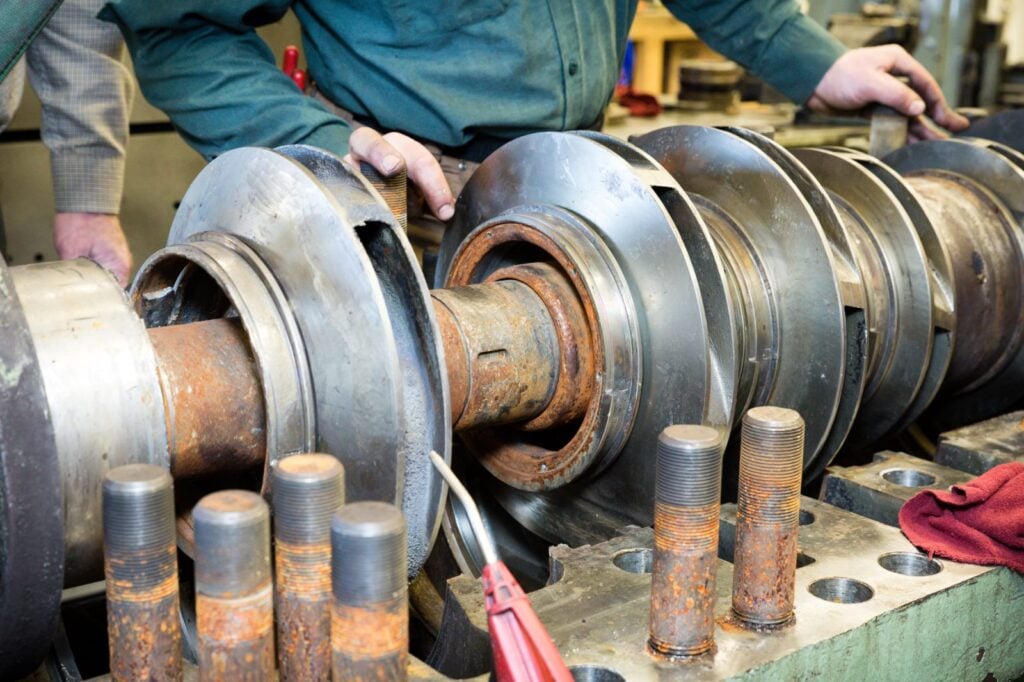
Technicians inspecting a worn multistage centrifugal pump rotor in its lower casing during a rebuild

Positive Displacement Pump Rebuilding

Positive displacement pump rebuilding restores a reciprocating pump‘s power end, fluid end, or both. In the power end, a crankshaft and connecting rods convert rotation into straight-line motion. The fluid end uses that motion to push fluid out at high pressure.

We rebuild duplex, triplex and quintuplex plunger and piston pumps in single- and double-acting designs. That includes drilling mud pumps. Brands that come through our rebuild shop include Gardner Denver, National, Oilwell, Gaso, Union, Wilson Snyder and Wheatley.

These pumps serve saltwater injection, desalination, descaling, well drilling and oil and gas gathering pipelines. Frac service is one more example of their high-pressure work.

Power End Rebuilds

A power end rebuild covers the crankshaft, main and connecting rod bearings, crossheads, crosshead guides and gears. Crossheads are the sliding blocks that keep each plunger or piston rod moving in a straight line. We measure every journal and bore, then machine or replace any part outside the manufacturer’s tolerances.

We can reverse engineer obsolete gears and other worn parts. Our engineers measure the original part and model it in CAD (computer-aided design) software. That model becomes the basis for a new part.

We also inspect the lubrication system, since dirty oil quickly wears out new bearings.
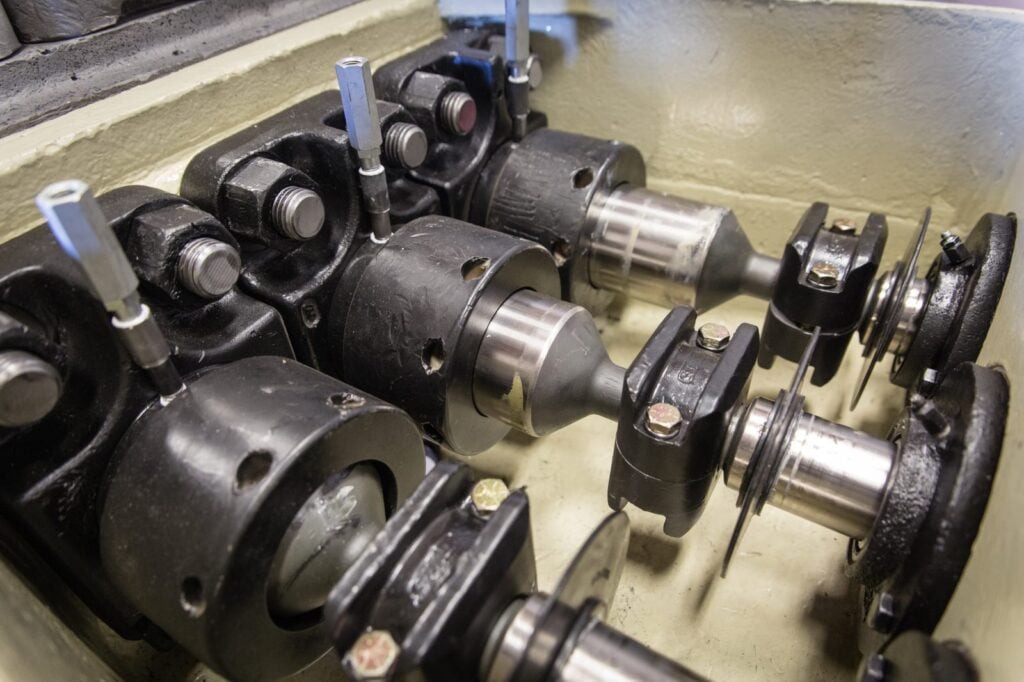
Crossheads and extension rods inside a reciprocating pump power end

Fluid End Rebuilds

A fluid end rebuild replaces the expendables, such as plungers or pistons, packing, valves, seats and springs. We also check the fluid end block for fatigue cracks.

Fatigue cracks grow from repeated pressure cycles, often where internal bores intersect. We can hydrostatically test rebuilt fluid ends up to 20,000 PSI.

See our case study on an Oilwell SA-634 rebuild, a pump that arrived from Nigeria with a damaged power end and fluid end. Another case study covers a Gardner Denver PZ-9 mud pump package rebuilt and shipped to Australia.

How Power Zone Rebuilds an Industrial Pump

Each industrial pump rebuild at Power Zone follows seven steps, from first analysis to final build report.

  1. Analysis and quote. We review the pump’s service history and operating conditions, then inspect it. Next, we send a scope and quote for your approval.
  2. Teardown and cleaning. Technicians take the pump down to bare parts and log each part’s condition. Cleaning and blasting then expose cracks, pitting and wear.
  3. Inspection and measurement. We measure clearances, fits and shaft runout, which is how far a shaft wobbles as it turns. Parts with suspected cracks get nondestructive testing.
  4. Machining and parts. Our machine shop restores worn fits and makes many replacement parts. Other parts come from OEM and aftermarket suppliers or from our own inventory.
  5. Reassembly and balancing. We reassemble the pump to the required clearances and balance the rotating assembly on centrifugal pumps. We record each final measurement in the build report.
  6. Testing. We can test each rebuilt horizontal pump in our facility, which handles pumps of up to 4,000 HP. Tests can include flow, pressure, efficiency, vibration and NPSH, the suction pressure a pump needs to avoid cavitation. Customers can watch at our facility, over a live stream or on a recording.
  7. Build report and shipment. You receive a full build report with photos, measurements and any test results. We repaint the pump before it ships and can provide field support for start-up and commissioning.

We can also package the pump on a skid with a driver and controls built in-house. On skid packages, we align the pump and driver with laser alignment tools.
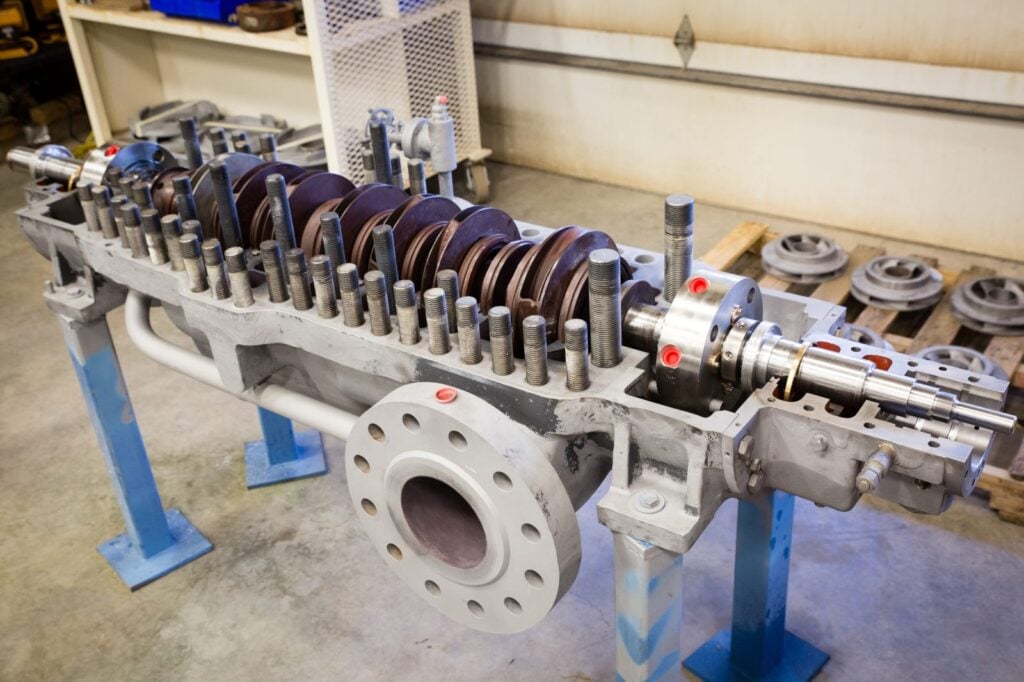
Multistage horizontal split case pump with its rotor set in the lower casing during reassembly

View a sample rebuild report from Power Zone Equipment

Multistage Split Case Centrifugal Rebuild Report

After the pump was shut down by the factory due to excessive noise and vibration, it was removed and sent to Power Zone Equipment. After the initial inspection and acceptance of work, the pump was completely rebuilt, reinstalled, and recommissioned in only 12 weeks.

Rebuilding vs. Replacing an Industrial Pump

Industrial pump rebuilding is usually the better value when the pump’s casing and major parts are sound and the pump still fits the job.

Choose a rebuild when:

  • Our shop can restore the casing, frame or fluid end block to specification.
  • The pump still matches the flow and pressure your system needs.
  • A new pump would take longer than the 8 to 12 weeks a full rebuild takes.
  • Some parts are obsolete, but we can reverse engineer them from the originals.

A replacement is usually the better choice when:

  • A cracked casing or fluid end block can no longer hold its rated pressure.
  • Your operating conditions have changed and the pump no longer fits them.
  • The rebuild would cost nearly as much as a replacement.

Power Zone can quote both options. Our inventory includes rebuilt pumps and parts, along with new, used and surplus equipment. It also carries power ends and fluid ends.

For new centrifugal pumps, Power Zone is a Flowserve and Sulzer dealer. You can also browse our in-stock reciprocating pumps and centrifugal pumps.

Request an Industrial Pump Rebuild Quote

To quote a rebuild, Power Zone needs a few details about the pump and how it runs:

  • Manufacturer, model and serial number
  • Operating conditions: the fluid, flow rate, pressure and temperature
  • The problem, or why the pump came out of service
  • Nameplate photos

Customers send pumps to our service shop in Center, Colorado, from throughout North America and overseas. Our team works with customers in English and Spanish.

To start, send a rebuild request. Our phone number is (719) 754-1981, and our email is sales@powerzone.com.

Frequently Asked Questions

How long does rebuilding an industrial pump take?

Power Zone’s full industrial pump rebuilds take 8 to 12 weeks. Each schedule depends on what we find at teardown, the machining required and whether we need to make new parts.

Your quote includes a schedule. In an emergency, we can fast-track the work.

Where can I get my industrial equipment rebuilt?

Power Zone provides industrial pump rebuilding for customers worldwide at its shop in Center, Colorado. The work covers centrifugal pumps, reciprocating pumps, power ends and fluid ends. Customers in more than 45 countries have received Power Zone equipment and workmanship.

When you compare options, look for a service center that machines parts in-house, tests the finished pump and documents every step. Power Zone does all three.

How much does rebuilding an industrial pump cost?

Power Zone prices each rebuild after an initial analysis, so the quote reflects the work your pump actually needs. Cost depends mainly on machining, replacement parts, any newly made parts and the testing you require.

Pricing is either quoted or cost-plus, and you approve each step’s cost before work starts.